

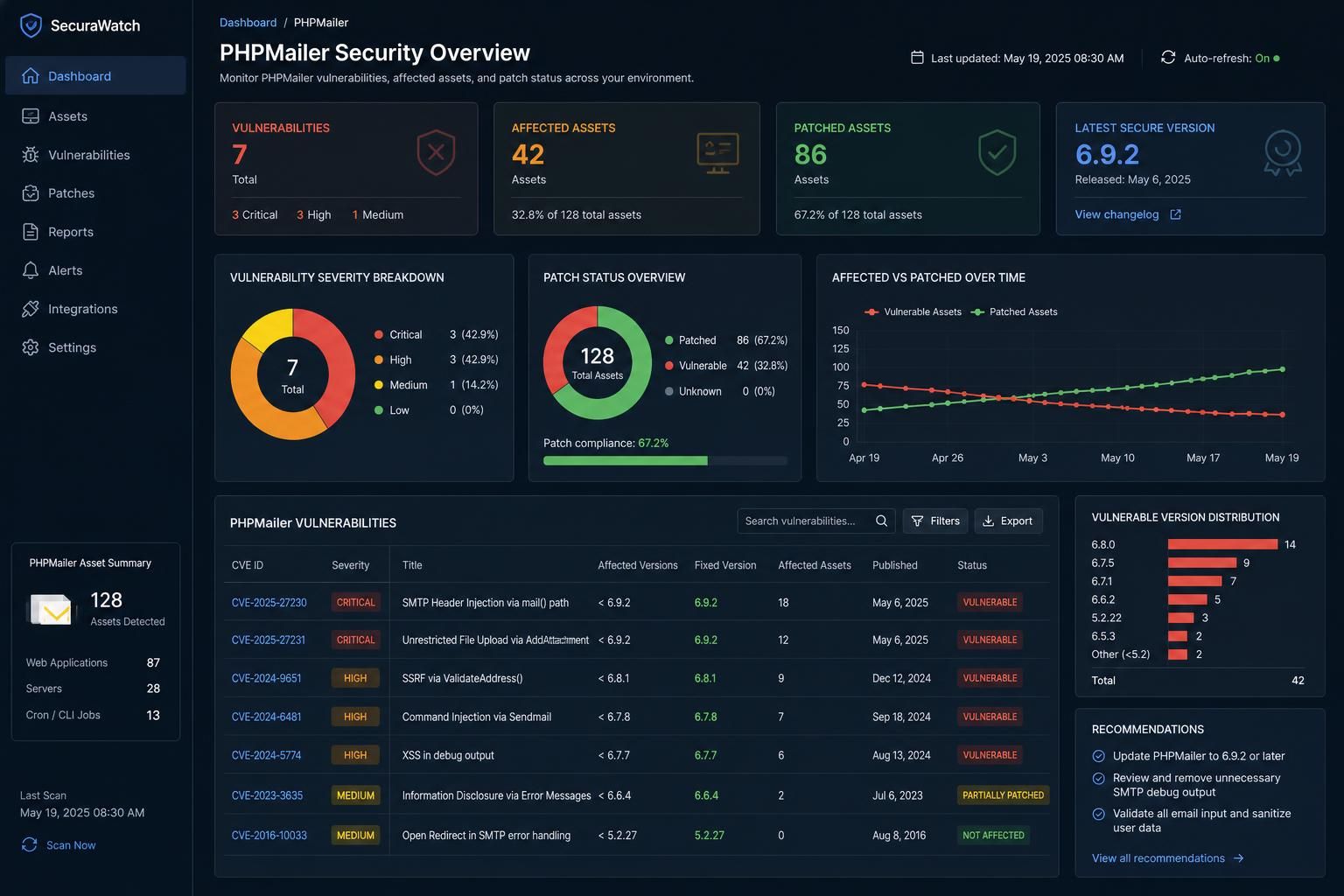
PHPMailer remains one of the most widely used tools in PHP applications for sending emails, yet its security history is fraught with vulnerabilities, emphasizing the imperative to carefully manage and pin versions. Over the years, documented Common Vulnerabilities and Exposures (CVEs) have exposed serious risks ranging from remote code execution to denial-of-service attacks. Developers and cybersecurity professionals must prioritize understanding these exploits and implement version pinning to mitigate threats, protecting sensitive communications and systems from compromise.
Key highlights in PHPMailer’s security evolution include multiple critical CVEs affecting versions prior to 6.5.0, some permitting execution of arbitrary code on systems running vulnerable releases. The recurring nature of these issues underlines how even popular open-source libraries require stringent review, patch application, and dependency control. Version pinning becomes essential to prevent accidental upgrades to compromised builds or pulling in unsafe dependencies.
In this context, detailed analysis of PHPMailer’s CVE timeline, specific attack vectors, and mitigation techniques offers invaluable insights. Emphasizing secure coding practices around PHPMailer integration, constantly monitoring releases, and embedding robust risk mitigation strategies help organizations maintain resilience against email injection exploits and evolving threat landscapes.
Understanding PHPMailer Security Vulnerabilities: What CVE Listings Reveal
“PHPMailer Security: CVE History and Why You Must Pin Versions” clearly refers to the compilation of known security flaws in the PHPMailer library and the crucial practice of locking dependencies to safe versions. CVEs are standardized identifiers for vulnerabilities that help developers and security teams track and address risks systematically. At the protocol level, many PHPMailer vulnerabilities stem from insecure handling of user inputs in email generation functions or unsafe processing of file attachments, resulting in exploitable conditions like remote code execution, injection attacks, or denial-of-service states.
For example, CVE-2021-3603 relates to a vulnerability where malicious code can be executed if an attacker injects functions into the global namespace, exploiting the validator function in PHPMailer. Similarly, CVE-2020-36326 involves Phar deserialization through UNC pathnames in attachments, allowing attackers to trigger object injection, a grave breach in safe coding protocols. Each CVE corresponding to PHPMailer versions before 6.5.0 exposes a distinct flaw with different attack surfaces, requiring separate detection and mitigation approaches.
To distinguish these vulnerabilities and act decisively, developers should implement tests specific to each CVE: checking namespace pollution for CVE-2021-3603, validating attachment paths to detect Phar deserialization attempts for CVE-2020-36326, and scrutinizing input sanitization mechanisms overall. Such targeted verification aids in confirming the nature of the vulnerability unique to each PHPMailer version, enabling accurate patching and version pinning.
Remote Code Execution Via Function Injection (CVE-2021-3603): Diagnosis and Remediation
CVE-2021-3603 is a hallmark vulnerability in PHPMailer versions 6.4.1 and earlier, permitting remote code execution if untrusted code is injected into the global function namespace. The weakness lies within the validateAddress() method, which by default uses the string ‘php’ to select a validator function. If an attacker defines a global function named ‘php’, PHPMailer uses it inadvertently, enabling execution of arbitrary code.
Confirming this vulnerability requires identifying if the PHPMailer instance sets the $patternselect parameter to ‘php’ and verifying the global namespace for any custom ‘php’ functions. If such a function exists, especially injected by third-party libraries or malicious code, it signals the presence of this risk. Unlike other vulnerabilities, testing involves codebase inspection rather than external probing.
Remediation was introduced in PHPMailer 6.5.0, which restricts validator names from being simple strings, effectively blocking the use of ambiguous global functions. Pinning to 6.5.0 or later versions prevents accidental reopening of this vulnerability, especially important when libraries are auto-updated without constraints. Secure coding also demands auditing all external code to detect undesired global functions that could compromise PHPMailer’s internal workflows.
Test to distinguish this vulnerability:
- Check the PHPMailer version is ≤ 6.4.1.
- Verify if $patternselect is set to ‘php’ in code.
- Inspect the global namespace for ‘php’ functions.
- Attempt to trigger code execution with crafted inputs invoking the global ‘php’ function.
Object Injection via Phar Deserialization (CVE-2020-36326): Identification and Mitigation
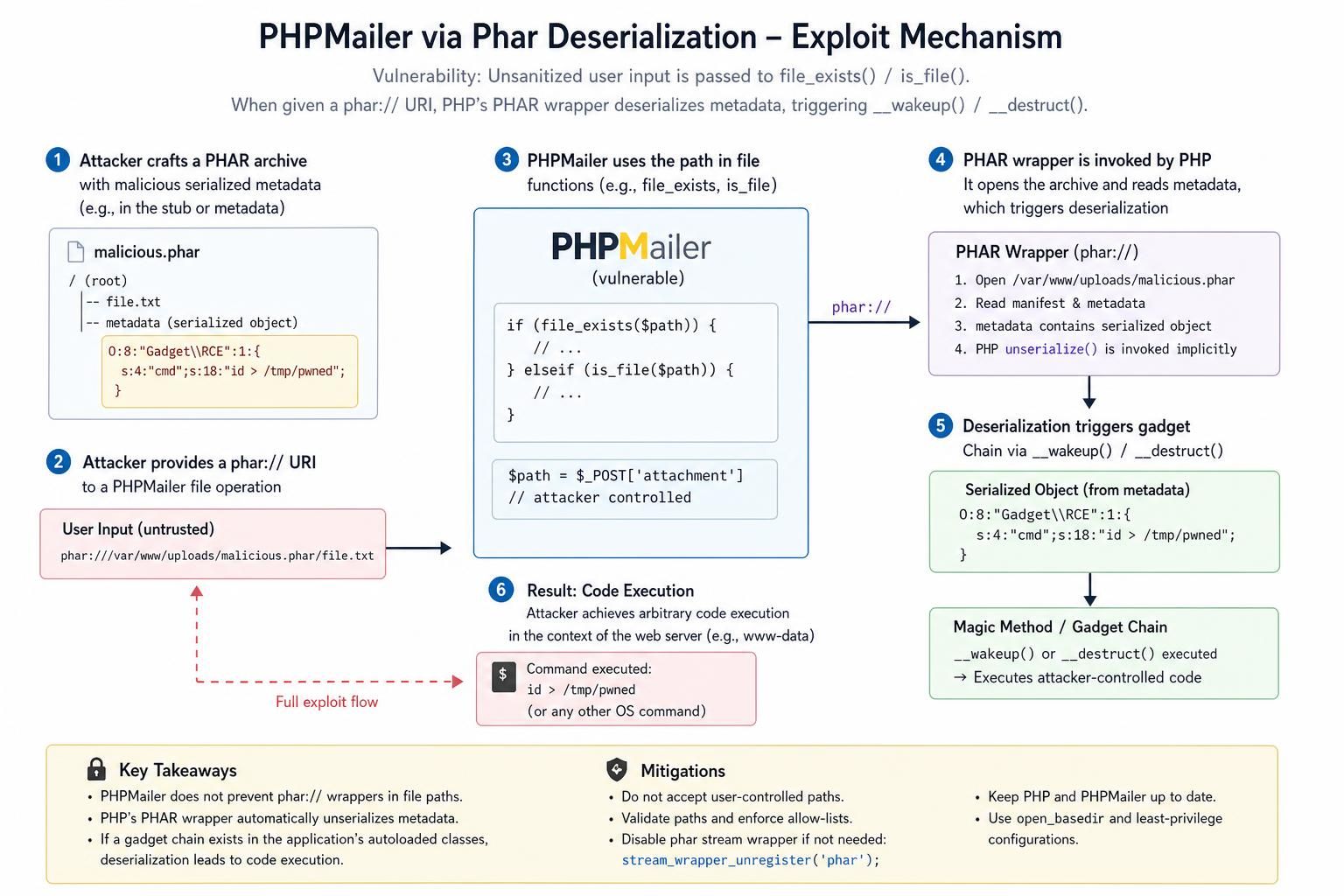
CVE-2020-36326 introduces an object injection vulnerability through Phar deserialization in PHPMailer versions 6.1.8 through 6.4.0. Attackers exploit the addAttachment() method when submitting filenames with UNC pathnames, tricking PHPMailer into processing malicious Phar archives. This issue arose after fixing a different problem related to UNC pathname handling, inadvertently removing code that blocked exploitation.
The core of this attack requires an abnormal attachment path that can be externally controlled. Security analysts can confirm this vulnerability by reviewing attachment handling routines, specifically how PHPMailer processes UNC paths and whether deserialization of Phar content occurs unchecked. Automated security scanners may flag suspicious file inputs that manipulate path schemes or embed Phar metadata.
The patch for this was incorporated in versions following 6.4.0, restoring proper validation and rejecting unsafe paths. Version pinning ensures deployments do not regress to vulnerable releases. integrating file path sanitization and restricting attachment types reduces exposure. Monitoring logs for abnormal attachment patterns can provide early indicators of exploitation attempts.
How to differentiate this vulnerability:
- Confirm PHPMailer is between versions 6.1.8 and 6.4.0 inclusive.
- Review if addAttachment() accepts user-supplied UNC pathnames.
- Conduct tests with crafted Phar files as attachments to observe deserialization behavior.
- Scan for error logs indicating suspicious file handling or deserialization exceptions.
Email Injection and Header Manipulation Risks in Older PHPMailer Versions (CVE-2015-8476 and Others)
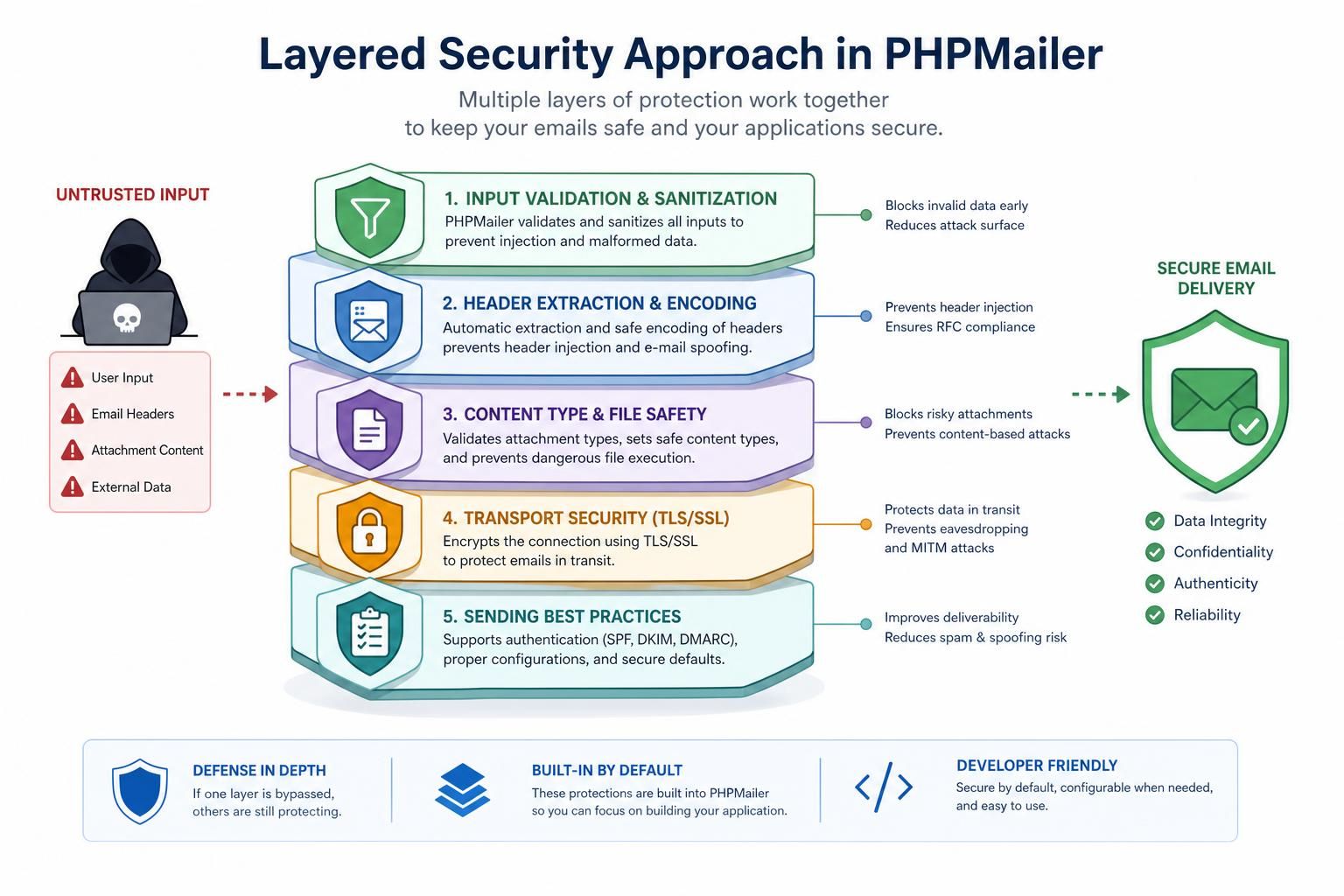
Earlier PHPMailer versions before 5.2.14 suffered multiple CRLF injection vulnerabilities as detailed in CVE-2015-8476. Attackers could inject arbitrary SMTP commands by embedding carriage return and line feed sequences into email addresses or SMTP command fields. This manipulation enabled arbitrary headers or command injection during mail transmission, compromising email integrity and increasing phishing or spam risks.
To confirm if this applies, security teams can test input fields for CRLF sequences and monitor SMTP interactions for unintended commands. Environments that still use legacy PHPMailer builds without proper escape routines in validateAddress() or sendCommand() functions remain at risk.
Resolution involved patching PHPMailer to properly sanitize and reject inputs containing CRLF outside intended contexts. Yet, remnants of such exploits remain notable risks where legacy systems persist. Version pinning and applying patches early mitigated ongoing email injection threats, but vigilance in input validation remains crucial.
Distinguishing factors of these risks:
- Legacy PHPMailer version earlier than 5.2.14 in use.
- Testing inputs for embedded CRLF characters.
- Intercepting SMTP commands to detect injected sequences.
- Confirming that email header validation is not applied or is flawed.
When Standard Patching and Version Pinning Fail: Legacy Vulnerabilities and Complex Scenarios
Although patching and version pinning provide robust defenses against many PHPMailer vulnerabilities, certain failure modes demand additional scrutiny. Legacy applications stuck on outdated versions pose persistent risks even after known patches exist. In some scenarios, improper deployment or partial patch application leaves exploitable gaps.
For instance, CVE-2016-10045 illustrates how flawed interaction between PHP’s internal escaping and PHPMailer’s mail transport mechanism enabled remote code execution via command injection. Even after fixes, if developers employed workarounds or failed to upgrade completely, the system remained vulnerable. Similarly, CVE-2017-5223 showed that relative image URLs could be coerced into attachments if unfiltered HTML input was used without base directories specified, a complex vector potentially overlooked in patch cycles.
These cases underline that beyond merely applying versions and patches, effective PHPMailer security demands holistic secure coding, comprehensive input validation, and vigilant runtime monitoring. Organizations should adopt continuous integration of security checks and tools such as detailed SMTPDebug outputs—with guidance from the SMTPDebug reference article—to observe mail transmission behavior and detect anomalies early.
| Vulnerability | Affected Versions | Primary Risk | Mitigation |
|---|---|---|---|
| CVE-2021-3603 | ≤ 6.4.1 | Remote Code Execution via function injection | Upgrade to 6.5.0+, avoid simple string validator names |
| CVE-2020-36326 | 6.1.8 – 6.4.0 | Object injection through Phar deserialization | Upgrade beyond 6.4.0, validate attachment paths |
| CVE-2015-8476 | < 5.2.14 | Email header injection via CRLF sequences | Patch to 5.2.14 or later, sanitize inputs |
| CVE-2016-10045 | < 5.2.20 | Remote code execution via mail command injection | Apply fix in 5.2.20, audit mail transport usage |
These risk scenarios highlight the importance of version control and continuous monitoring, as simple patch application is not always sufficient in complex real-world deployments.
Why is version pinning critical for PHPMailer security?
Version pinning ensures that applications use known secure versions of PHPMailer, preventing accidental upgrades to vulnerable releases or the inclusion of insecure dependencies. This practice reduces the risk of newly introduced vulnerabilities and stabilizes application security.
How can I detect if my PHPMailer is vulnerable to the CVE-2021-3603 issue?
Check if your PHPMailer version is 6.4.1 or earlier, if it uses the default ‘php’ validator, and inspect your global PHP namespace for functions named ‘php’. Code audits and tests simulating namespace injection can confirm presence of this vulnerability.
What measures prevent Phar deserialization attacks in PHPMailer?
Upgrading PHPMailer beyond version 6.4.0 is vital, as patches improve validation and reject unsafe UNC pathnames. enforcing strict file input sanitization and restricting attachment formats strengthens defense against object injection.
Can SMTPDebug logs help identify PHPMailer exploits?
Yes. Detailed SMTPDebug output allows administrators to track SMTP command sequences, identify anomalous injection attempts, and monitor for misuse. For practical usage, refer to the SMTPDebug reference article for configuration and interpretation tips.
